

If you can clearly hear that someone is speaking but struggle to make out the actual words — particularly in a busy restaurant, a group, or a meeting — you are describing one of the most common early signs of a change in hearing. Here is the key point that surprises most people: hearing sound and understanding speech are not the same thing. You can have plenty of volume and still lose clarity, because the two rely on different parts of how we hear.
Hearing sound and understanding speech are not the same
It is easy to assume hearing is simply about how loud things are. In reality, following a conversation is about clarity — picking out the fine detail that tells one word apart from another. Many people with an early hearing change hear that a voice is present without difficulty; what they lose is the sharpness that turns sound into meaning. That is why you can genuinely feel your hearing is “fine” at home, yet find yourself lost the moment there is background noise or several people talking.
Why consonants and speech detail matter
Speech is a mix of loud, low-pitched vowels and soft, high-pitched consonants. The vowels (a, e, o) carry most of the volume, but the consonants — s, f, th, k, sh — carry most of the meaning. Unfortunately, consonants are exactly the quiet, high-frequency sounds that a hearing change tends to affect first. So the parts of words that help you tell “cat” from “cap” or “fifteen” from “sixteen” become blurred, while the overall loudness of speech stays much the same. The softer parts of words, and anything said quickly or against competing sound, are the first to slip away.
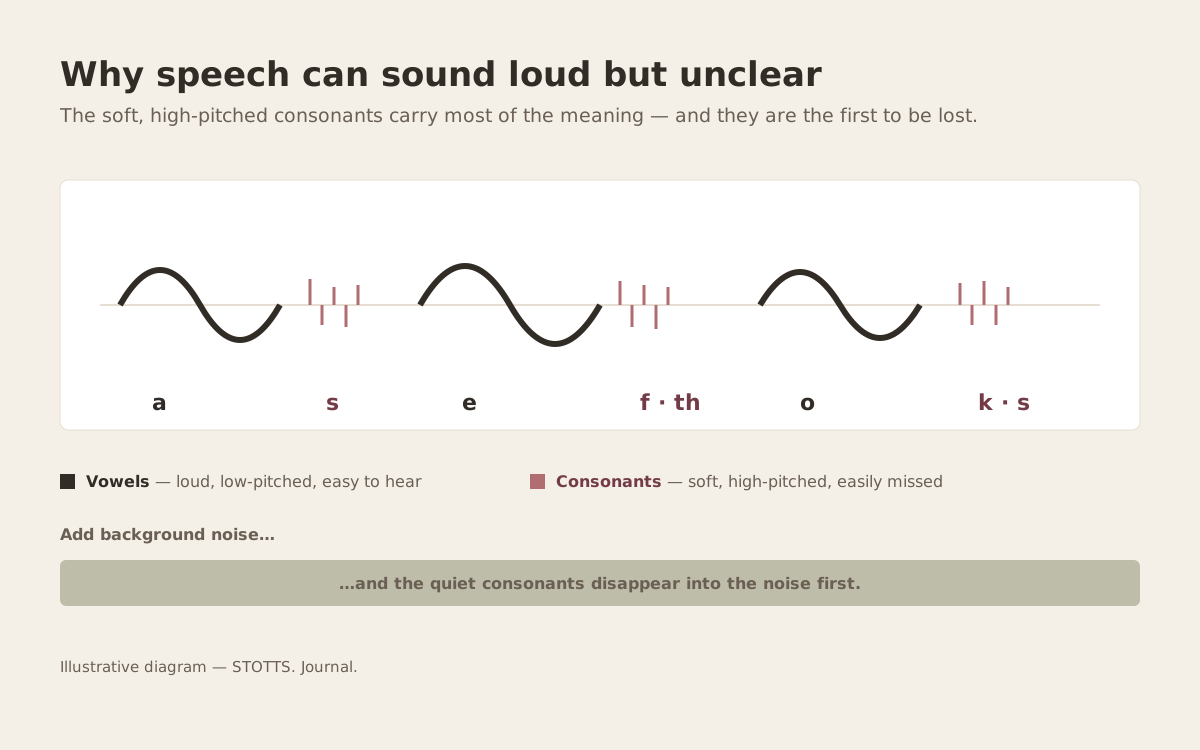
Why background noise makes it so much harder
When the room is quiet and someone is facing you, your brain can fill in the small gaps. Add competing sound, and that becomes far harder. This is why the difficulty is usually most obvious:
- In restaurants and cafés
- In groups and at social gatherings
- During meetings
- When people speak quickly
- When the speaker is facing away or in another room
- When several people talk at once
- When television dialogue competes with background music
- When you are tired at the end of the day
When parts of speech are missing or unclear, your brain has to work harder to piece the sentence together from context. That effort is real — it is why so many people describe feeling drained after a noisy meal or a long day of meetings, even when they have “heard” everything. It is not a failure of concentration; it is the extra work of listening with less detail to go on.
Why turning up the volume may not solve it
The instinctive fix is to make things louder — turn up the television, ask people to speak up. But if the problem is clarity rather than volume, louder simply makes everything bigger, including the parts you could already hear and the background noise you are trying to ignore. The quiet consonants that carry the meaning still are not sharp. That is exactly why people turn the TV up and yet still reach for subtitles: more volume, no more clarity.
Other possible causes and contributors
Difficulty understanding speech is not always a permanent hearing change. Several other things can contribute, which is why it is worth having it looked at rather than guessing:
- Ear wax or a temporary blockage dulling the sound reaching your ear
- Middle-ear problems, such as fluid after a cold
- Asymmetrical hearing, where one ear is doing more of the work
- Poor room acoustics — hard surfaces and echo
- Attention and fatigue, which reduce how much detail your brain can recover
What a hearing assessment checks

This is where a proper assessment is so useful, because it measures the very thing you are struggling with. Alongside a full diagnostic hearing test, our hearing assessments include speech testing and speech-in-noise testing — checking how clearly you understand words, and how you cope when there is background noise. That paints a far more realistic picture than a simple “can you hear this beep?” test, and it means any advice reflects how you actually live. We also look inside your ears first, so anything simple like wax is picked up straight away.
Signs it is worth arranging an assessment
- You often hear speech but cannot make out the words
- You struggle most in restaurants, groups or meetings
- You turn the television up, or rely on subtitles
- You ask people to repeat themselves
- Others have started to notice before you do
- You feel worn out after a day of listening
If any of these feel familiar, a quick online hearing test — or, better still, a full hearing assessment — is a calm, straightforward next step. And if it turns out support would help, modern hearing aids are discreet and designed specifically to lift the clarity of speech, not just make everything louder.
When to seek urgent advice
Most difficulty understanding speech develops gradually and is not urgent. But some symptoms need prompt medical attention. Please contact your GP or NHS 111 promptly — or seek same-day advice — if you experience:
- Sudden hearing loss, especially over hours or a few days
- Hearing loss in one ear
- Hearing loss accompanied by dizziness or balance problems
- Any neurological symptoms, such as weakness, facial droop or slurred speech
- Severe ear pain or discharge
Struggling to follow words in a noisy room is one of the most common — and most fixable — signs of a hearing change. Understanding why it happens is the first step towards hearing clearly again.← Back to the Journal