
A new kind of care experience — vision, hearing and confidence, considered around you. Book an appointment →
Book Appointment

Lenses · Lens Profile guides

Are expensive glasses lenses worth it? Sometimes. But not for the reasons you might think.

Price tells you what a lens costs. It doesn't tell you what it was configured to do.

This is a guide, not an eye test — any change in your vision is an examination first.

The straight answer

Sometimes, yes — when the extra money buys a design or a coating that addresses something your day genuinely asks of your eyes. Often it buys a more advanced design fitted to default values, which is money spent on the wrong half of the problem. And sometimes the answer is no — we'll say so.

What the money can buy

Five things a lens price is made of. We decide each one separately.

A price card rolls them into a tier. A configuration takes them one at a time, and only for a reason you gave us.

  1. 01

    The design

    A general-purpose varifocal, an occupational design set around a working distance, a single-vision lens with near support, a sports design. Design is where the money most often matters — and most often goes to waste when it is chosen by tier rather than by your distances.

  2. 02

    The material and index

    Thinner, lighter lenses for stronger prescriptions. Worth paying for when your prescription asks for it; invisible when it does not.

  3. 03

    The coating

    Anti-reflection, scratch resistance, a driving coating for glare after dark, a contrast coating for dim-light reading. Each has a reason. None should be added by default.

  4. 04

    The light layer

    Lenses that react to light, or a polarised sun pair — chosen for the light you actually live in, not bundled in.

  5. 05

    The one nobody itemises: measurement and dispensing time

    Working distances, fitting heights, corridor, position-of-wear values where the design accepts them, and a review after you collect. This is the part that decides whether any of the above performs — and it never appears on a price card.

When more money changes nothing

Three ways to spend more and see no differently.

A low prescription, short screen days, no night driving, none of the habits

The honest configuration is STOTTS. Everyday — and it may be close to what you already have. Screens aren't a big enough part of your day to justify a pair of their own. When nothing you told us earns a change, the Lens Profile says so; Everyday is the configuration that can honestly be nearly nothing.
A more advanced design fitted to the defaults

Wrap angle, pantoscopic tilt and vertex distance all have default values. A design that accepts measured values but is ordered on the defaults has been paid for and not used — the extra money bought a capability nobody switched on.

A coating for a problem you don't have

We do not suggest a filter coating simply because you use screens. Coating chosen for a reason you gave us — never added to raise the price. If you have not described reflections, scratches, dazzle after dark or dim-light reading, a coating is not the change your day is asking for.

When it changes everything

Three days where the right configuration is the whole difference.

In each of these the money goes on the thing your day actually asks for — and the card is honest about what it will not do.

Desk-dominant days on a general-purpose varifocal

STOTTS. Screen

For screen- and desk-heavy days — a lens configured around your working distances rather than borrowed from an everyday lens: the desk, the screens, the people across it and, where the day spans it, the room.

Desk and room variants (E-Life Pro): not for driving — the guide states "Lens design not suitable for driving". It would live at your desk.

STOTTS. Screen

Dazzle in dim light and dark driving

STOTTS. Drive

The guide positions SeeCoat Next Drive as ideal for those who experience glare in dim light and dark conditions. Drive is a light-layer configuration: the lens design underneath stays whatever your everyday configuration is, and the coating is the change.

A coating cannot fix distance clarity — if road signs are the issue, that is a prescription check first.

STOTTS. Drive

Several distances, and a hunt for the clear bit

STOTTS. Precision

For days that ask a lot of your eyes at several distances — the same everyday progressive design, configured around every distance you use, your frame and how you adapt. Precision describes what STOTTS measures and discusses; it is never a price tier and never a Nikon tier.

Position-of-wear — how the frame sits: wrap angle, pantoscopic tilt, vertex distance — measured in practice where the design accepts it.

STOTTS. Precision
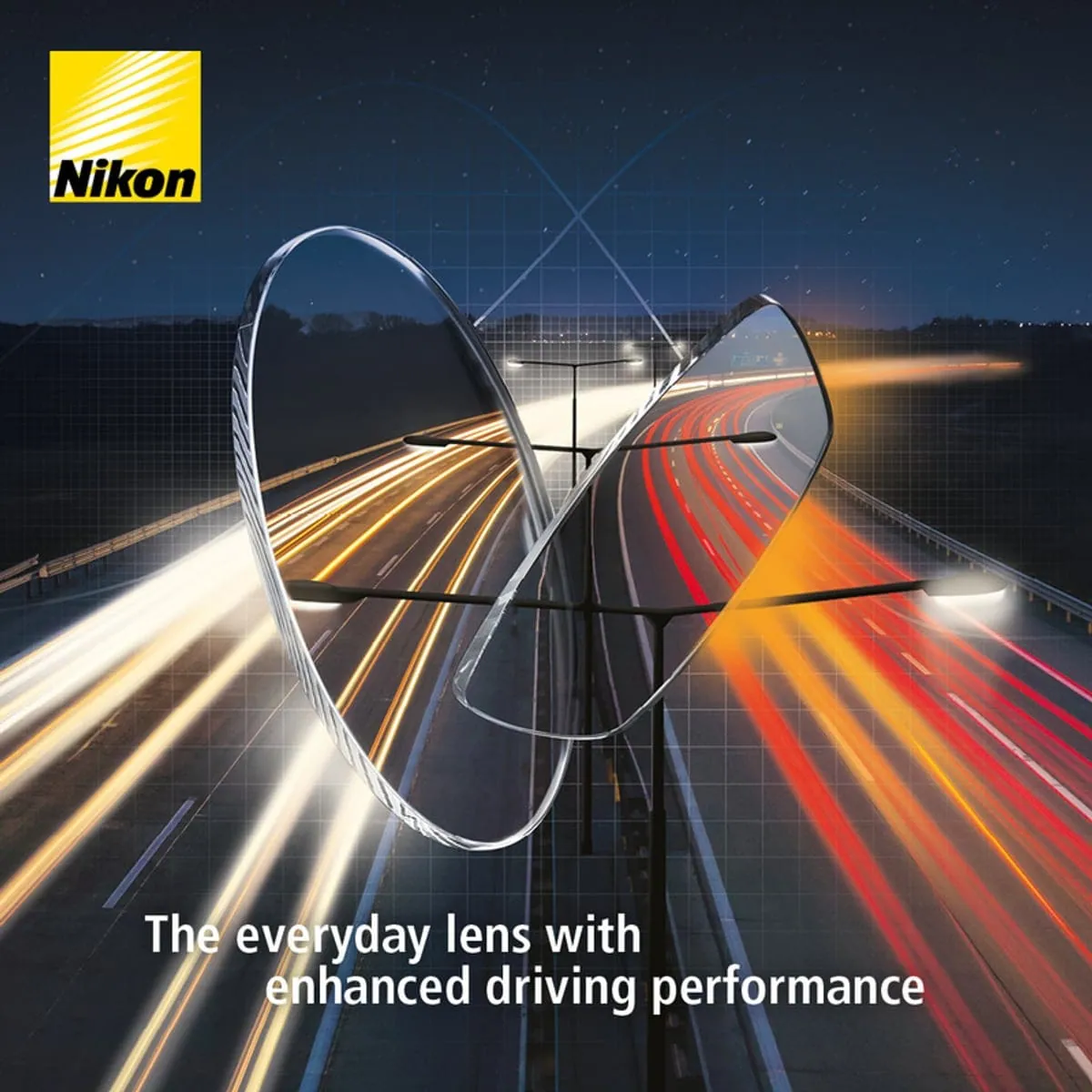
A pair of spectacle lenses over a motorway at night, headlight and tail-light trails streaking past
Imagery: Nikon Lenswear

Positioning quoted from the Nikon Lenswear Dispensing Guide 2026. Lens technology: Nikon Lenswear. Configuration: STOTTS.

The compromise you've stopped noticing

Before you ask whether a lens is worth more, ask what you are already doing to make the current one work.

These are the habits people describe to us most often. None of them is a fault; all of them are information. If several of these are you, the question is not whether to spend more — it is what the money should go on.

See where you may be compromising
  • You lift your chin.
  • You turn your whole head between screens.
  • You move your head around to find the clear bit.
  • You lean closer.
  • You take your glasses off.
  • You look over the top of your glasses.
  • You swap between pairs.
  • You have moved your monitor to suit your glasses.
  • You have made the text bigger.
  • You search for the right bit of the lens.

The rule we work to

Every recommendation the Lens Profile makes is held to one rule: the least complex solution that properly addresses the identified need. Never the highest tier by default.

That rule is why the profile can name a configuration and, just as readily, tell you to keep what you have. It also means there is a list of things we will not recommend, and why — read what we won't recommend.

Pricing, honestly

The configuration decides the pair. The price follows.

We don't publish lens prices by tier, because we don't sell tiers. The figures we do publish are the ones every page on this site reads from the same place, so they cannot drift:

A complete second pair starts from £99 for single vision and £199 for a varifocal; members save 20% on complete eyewear and 50% on an additional complete pair within 90 days.

Whether a second pair is worth it at all is decided by your day, not by the offer — the profile tells you when a task pair would genuinely do a job better, and when it would mostly duplicate what you have.

The questions people ask about price.

Will you tell me if I don't need to spend more?

Yes. When nothing you told us earns a change: your current set-up, kept, with what is working said out loud. That is a real answer, not a soft one. We would rather tell you that than sell you a configuration.

Is a more expensive varifocal automatically a better one?

No. Which design is right is a dispensing decision — the difference between designs depends on your prescription, current lens, measurements and adaptation history. We name the family, not the final lens.

Do I need a coating because I use screens?

No. We do not suggest a filter coating simply because you use screens. A coating is chosen for a reason you gave us — reflections, scratches, night driving — never by default.

Why can the same prescription cost different amounts?

Because the prescription is only one of the decisions in a pair of glasses. The design, the material, the coating, the light layer and the measurement time each change the cost — and each should be there for a reason you gave us, not because a bundle included it.

Three minutes, no sign-up to start

Find out whether your day is asking for more — or for nothing at all.

Tell us about screens, driving, reading and the habits you've picked up, and we'll show you the configuration we'd build, or say plainly that the pair you have is doing its job.

See where you may be compromising

This is a guide, not an eye test — any change in your vision is an examination first.

Book appointment