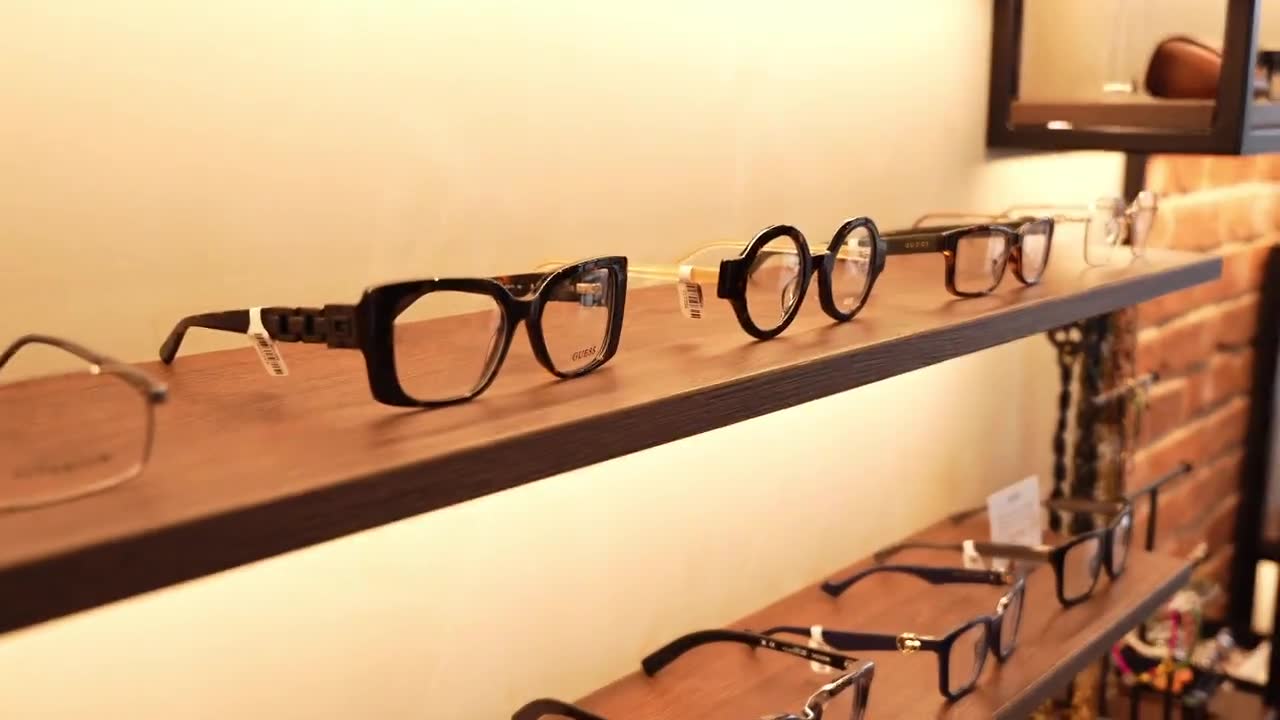
Most eyewear trend pieces list whatever appeared at the last set of shows. This is a shorter and more sceptical list: the things we have seen enough of, on enough real faces, to believe are worth your money — and the ones we would think twice about, since you will be wearing the result every day for three years.
What we are pleased about
- Titanium at sensible prices — lighter, stronger and far kinder to a nose over fourteen hours than it used to be affordable to be
- Proper colour in acetate — greens, ambers and smoked neutrals that are neither black nor the same tortoiseshell everyone has had since 2009
- Bigger lenses coming back, which is genuinely good news optically as well as visually, because it gives varifocals room to work
- Adjustable nose pads on acetate, which used to be rare and solves a real fit problem for a lot of faces
- Frames designed around a lens rather than in spite of one — more makers are thinking about depth and base curve at the design stage
Why lens size matters more than it looks
The very small frames of the late 2010s were a genuine problem for anyone in varifocals, because a progressive lens needs vertical room for the intermediate and reading zones. A slightly larger eye size gives the design somewhere to go. It is unusual for fashion and optics to point the same direction; this is one of those times, and we would take advantage of it while it lasts.
What we would be cautious about
Very narrow rectangular frames, which look striking on a shelf and leave varifocal wearers hunting for the reading zone. Extremely heavy acetates, which are fine in the shop and sit on your nose all day. And any frame where the arms are decoratively thick at the hinge — it is a look, and it is also the place frames break.
Colour, and the one worth trying
If you have worn black or tortoiseshell for a decade, the useful experiment is not a bright colour, it is a muted one you have never considered — a smoked olive, a warm grey, a deep amber. They are far more wearable than people expect and they do something for skin tone that black does not. Ask us to put one in front of you; the worst case is that you have tried it.
On lens developments
We are deliberately not naming lens products here. The genuine improvements of recent years — individually calculated surfaces, wider intermediate zones, better coatings — are discussed properly in what has changed in varifocals, and they matter more than anything happening to frame silhouettes. A trend in a frame changes how you look. A change in lens design changes what you see.
The only trend advice worth much
You will wear these every day, in every photograph, for around three years. That is long enough for a strongly of-the-moment frame to date and short enough that a completely safe one is a wasted opportunity. Somewhere in between is usually right, and trying the one you would not have chosen is still the fastest way to find it.
A frame has to survive three years of photographs. That is the only trend test that has ever mattered.← Back to the Journal