
You play weekly, or a few times a month
Not how seriously you take it — how often the lens would actually be worn. A pair built for a wrap frame earns its place through use, and a round every few months does not generate enough of it.
Lenses · Sport
This is a guide, not an eye test — any change in your vision is an examination first.
The obvious answer to golf is a three-zone lens, because a round obviously involves three distances. The obvious answer is often wrong. A lens with more zones has more transitions to fit, and in a wrapped frame those transitions are harder to place — so adding a zone you do not use costs you something in the zone you do. The useful question is not how many distances exist on a golf course. It is how many of them you personally switch between while you are playing.
The honest test
The Lens Profile only names a sports configuration when both are present. One without the other is not enough, and we would rather tell you that than take the order.
Not how seriously you take it — how often the lens would actually be worn. A pair built for a wrap frame earns its place through use, and a round every few months does not generate enough of it.
Distance in motion, glare off the grass, or genuinely switching between scorecard, ball and green. “I wear glasses and I play golf” is not a visual demand; “I cannot read my card without taking my glasses off on the tee” is.
Sports lenses — “You play now and then rather than every week — sport-specific eyewear is not indicated.”The Lens Profile’s wording, word for word, for occasional play.
One, two or three
Quoted from the Nikon Lenswear Dispensing Guide 2026, which describes the benefit of each design in a single line. We use those lines rather than our own, and we confirm the number of zones with you in practice.
One zone
“stable 360° field of view even at the edge of the lens”
For most golfers who do not need a reading correction on the course, this is the honest answer. A single stable distance zone, edge to edge, in a frame that wraps — nothing to hunt for as your head turns through a swing.
Two zones
“flexibility for nearer viewing without compromising distance performance”
A nearer zone added for the card, the yardage book or the rangefinder, without giving up the distance view. Which of the two ordering types applies is decided by your confirmed reading addition, not by preference.
Three zones
“smooth transition between wide fields of view with minimum sway”
The full progression, for players who genuinely move between all three distances during a round. It is the most complex thing to fit in a wrapped frame, which is exactly why we only reach for it when the answers earn it.
A near or intermediate zone only when you wear a reading correction and told us you switch distances when you play — never "over 40, therefore multifocal". Age tells us that a reading addition is likely; it tells us nothing about whether you use one on the course. Plenty of golfers in their fifties read the card quite happily at arm’s length, play in a distance-only pair and would be worse off with a corridor in front of them on the tee.
Number of visual zones — one, two or three — confirmed from what your sport asks of you. Two-zone designs: Sports 2 or Sports 2 HI decided by your confirmed addition (+1.75 or less / +2.00 or more)
What the frame changes
Curve the lens around the face and the light no longer arrives square to it. The design has to be calculated for that, which is why a sports lens is specified differently from an everyday one — and why a sports frame glazed with an ordinary lens rarely feels right at the edges.
A wrap sports frame is not an everyday or office pair. It is a pair for the round, kept with the clubs.
Glare on the course — and on the drive there
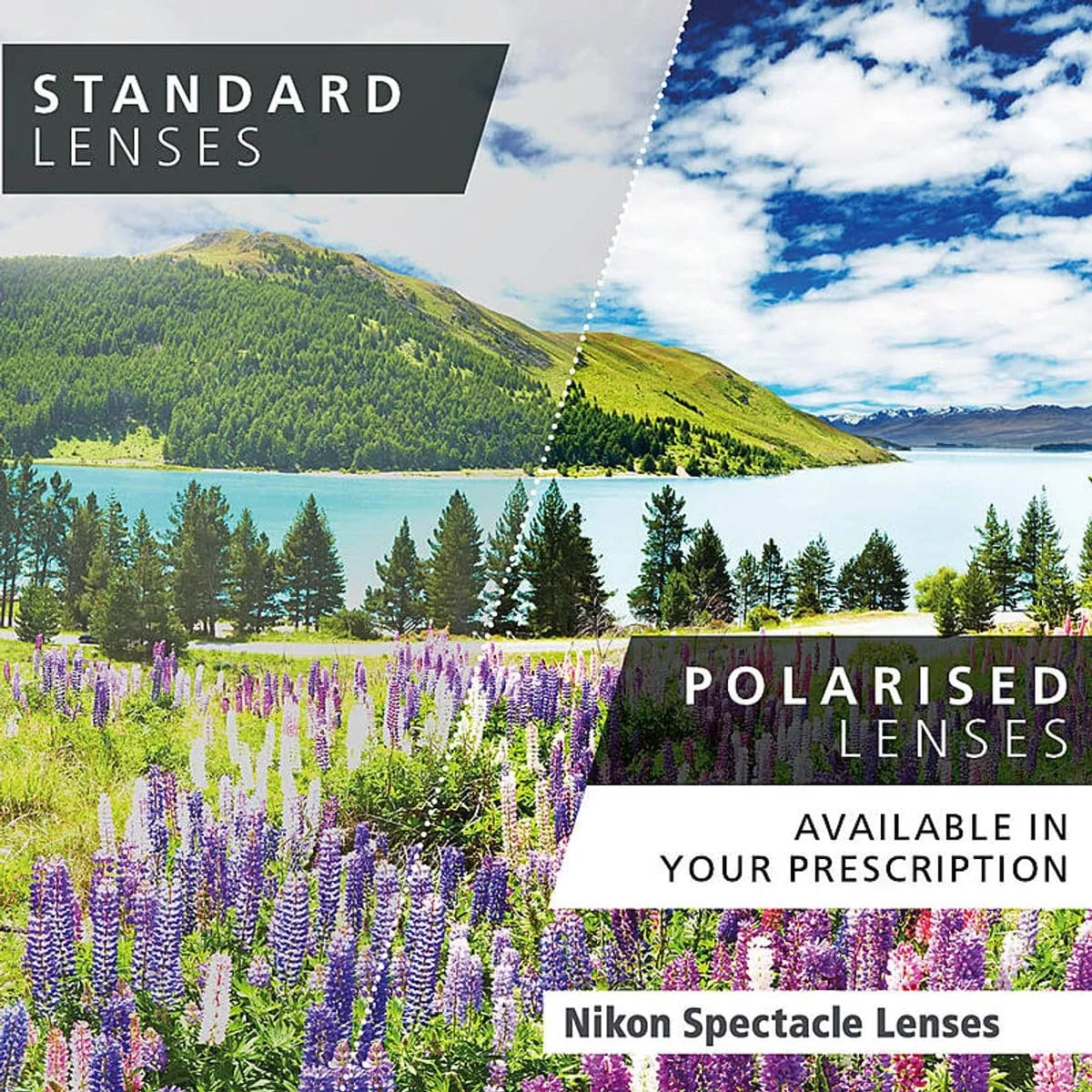
Low sun across a fairway, reflection off wet grass and the bright sky behind a ball in flight are all reasons a golfer might want a polarised lens, and on the course polarisation does real work. Some players dislike it for reading a green, so it is a choice we make with you rather than for you — tint, mirror or polarised option chosen for the sport, in practice — custom tint matching at 1.67 and 1.50.
The confusion starts in the car park. A lens that reacts to light and polarises outdoors is not the same thing behind a windscreen, and the guide is specific about it:
Reactive and polarised (XTRActive Polarized): behind a windscreen the guide states polarisation efficiency is 30%, which is not classified as polarised — so this is not a substitute for dedicated polarised sunglasses when driving.
Driving check stated before the choice: behind a windscreen polarisation is 30%, not classed as polarised. If the drive to the course matters as much as the round, that is usually a conversation about two pairs rather than one clever one.
The configuration
For regular sport with a genuine visual demand — golf, cycling, running, racquet sports, shooting — a lens designed for the curve of a sports frame, with a stable view to the edge, and as many visual zones as your sport actually asks for.
What is in the configuration
Lens technology: Nikon Lenswear. Configuration: STOTTS.
Sports vision at Brown Opticians, Burnley
Every STOTTS. practice can dispense an Active configuration — the measurements and the ordering parameters are the same wherever you are seen. If you want to go past the lens and talk about vision in sport itself, there is one credential in the group worth knowing about: Clive Duerden, optometrist at Brown Opticians in Burnley, holds a Diploma in Sports Vision. That credential is published for Burnley only, and it belongs to him rather than to the group.
Separately, our clinical team runs a football-specific vision screening programme with Burnley Football Club, delivered through Mr Jinkinson’s in Padiham. It is a different piece of work with a different team, and we mention it here only because it is the clearest illustration of what sport-specific vision assessment involves beyond a lens choice — read about the Burnley FC screening in the journal.
We do not claim sports-vision qualifications we do not have, and we do not attribute one clinician’s work to another. If a sports-vision consultation is what you want, ask us and we will tell you honestly where to go for it.
No. The profile only names Active for weekly or monthly play with a specific visual demand. Occasional play is not indicated — and we would rather say so.
Only as many as your sport asks for. A three-zone design is considered only when you wear a reading correction and told us you switch between scorecard, ball and green when you play. Otherwise one stable distance zone is usually the honest answer.
Because it is compulsory on every SeeMax Sports design, and position-of-wear is included as standard on them — so Active is the one configuration where both can be stated online.
Every practice can dispense an Active configuration. Clive Duerden, optometrist at Brown Opticians in Burnley, holds a Diploma in Sports Vision — that credential is published for Burnley only.
STOTTS. Lens Profile
Three minutes about how often you play, what you actually look at while you are playing and what gets in the way — and we will show you whether one zone, two or three is the honest answer, or whether sports eyewear is not indicated for you at all.
This is a guide, not an eye test — any change in your vision is an examination first.