
A new kind of care experience — vision, hearing and confidence, considered around you. Book an appointment →
Book Appointment

Lenses · Night driving

Glasses for night driving: it's usually the coating — unless it's your prescription.

Headlights, wet roads and dim light are a light-management conversation. Road signs are a prescription conversation. We check which one you're having first.

Most people searching for night-driving glasses have one of two problems, and they feel the same from the driving seat: dazzle from oncoming headlights and wet roads, or road signs that sharpen later than they used to. One is a coating conversation. The other is a prescription conversation. The Lens Profile — and the people who dispense from it — check which one you're having before naming anything.

This page is not an eye test — any change in your vision is an examination first.

Two problems that feel the same

Glare, or clarity? The Lens Profile routes them differently.

A light-management conversation

Glare after dark

A lens and coating chosen for dim and dark driving — this is a light-management conversation, not a new prescription.

What people tell us

  • Oncoming headlights that bother you
  • Reflections in rain and on wet roads
  • Seeing in dim light feels harder
  • Evening drives you have started to put off

Where it goes: STOTTS. Drive — a coating on the pair you actually drive in, after the prescription is checked.

A prescription conversation

Distance clarity when driving

Road signs and distance clarity are a prescription question before they are a lens-design question — that's something we'd want to understand properly rather than guess online.

What people tell us

  • Road signs that sharpen later than they used to
  • Number plates and distant detail less clear
  • The same difficulty in daylight as after dark

Where it goes: An eye examination first — no configuration is named until the prescription has been checked.

“A coating cannot fix distance clarity — if road signs are the issue, that is a prescription check first.”The Lens Profile's own limit, written into every Drive recommendation it makes.

What a driving coating does — and doesn't

A coating manages glare. It does not change your prescription.

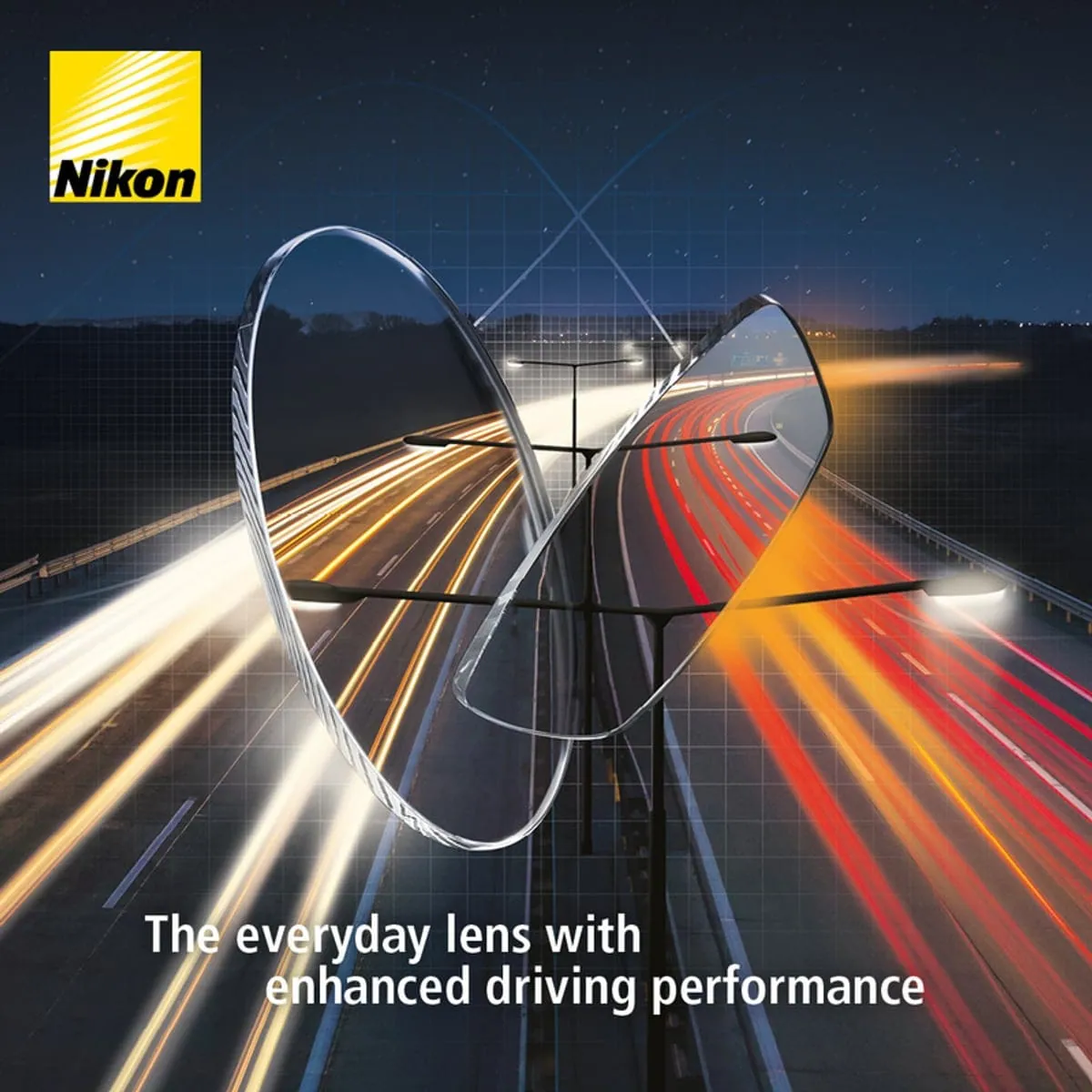
The coating we configure for night drivers is Nikon SeeCoat Next Drive. The Nikon Lenswear Dispensing Guide 2026 positions it in two lines, and we use no others: it is recommended for “those who experience glare in dim light and dark conditions”, and it is described as “the everyday lens with enhanced driving performance” — in other words, it lives on the lens design you already wear. Nikon SeeCoat Next Drive coating — on your everyday design. No driving-specific lens design exists in the guide and none is implied.

Its limit is stated on every Drive card the Lens Profile produces: a coating manages reflections and glare; it does not change your prescription or replace a prescription check if distance clarity is the issue. If it is road signs, the coating waits.

Standard anti-reflection
Nikon Lenswear image of a lens against night-time motorway light trails With a driving coating
An illustration of the kind of difference a coating aims at — not a simulation of your prescription or your eyes. Imagery: Nikon Lenswear.

Manufacturer footnotes, not medical claims

What we won't configure for a night driver.

Each of these is the manufacturer's own footnote from the Nikon Lenswear Dispensing Guide 2026, or the Lens Profile's own limit — not a claim about your eyes.

Tinted-indoors lenses

“Transitions Color Touch lenses are not suitable for driving in twilight or at night.”

The manufacturer's own footnote — and a component of every Drive configuration: no tinted-indoors lens is ever configured for a night driver.

The darkest sun tints

“not allowed for driving”

The guide marks its darkest solid sun tint with those three words. It is never configured as a driving pair, whatever the frame.

Yellow 'night-driving' tints

Not part of a STOTTS. configuration. Our rule is simpler than any claim made for them: nothing tinted indoors is configured for a night driver.

Transitions XTRActive Polarized, as a driving answer

“Behind a windscreen the guide states polarisation efficiency is 30%, which is not classified as polarised — so this is not a substitute for dedicated polarised sunglasses when driving.”

The Lens Profile states this before the choice, not after.

Lenses that react to light, as a night answer

“Not a night-driving solution in itself; that is a separate coating conversation.”

That is the Lens Profile's own line for everyday lenses that react to light. Transitions XTRActive is "clear indoors with a hint of tint" in the guide's words — worth weighing against evening driving.

The configuration

STOTTS. Drive — on your everyday pair, or a driving pair.

For people who drive a lot, and after dark — glare managed by the coating, on the pair you actually drive in, or on a dedicated driving pair when the wardrobe conversation says one is worth it. Drive is a light-layer configuration: the lens design underneath is whatever your everyday configuration is.

What is in the configuration

  • Your Lens Profile, checked against your prescription in practice
  • Prescription validated — night-vision symptoms checked against a prescription or clinical change first
  • Your current lens design, kept — the coating is the change
  • Coating chosen for a reason you gave us — never added to raise the price
  • Whether it belongs on your everyday pair or a driving pair — decided with you
  • Explained and, where available, demonstrated against a standard anti-reflection lens
  • No tinted-indoors lens is ever configured for a night driver
  • Fitting review after you collect — adjusted or put right if needed

Lens technology: Nikon Lenswear. Configuration: STOTTS.

If something has changed recently

A change in your vision is an examination first.

If driving after dark has become harder over recent weeks or months rather than years, the first step is an eye examination, not a coating. That is the route the Lens Profile takes as well, in its own words: “When the honest answer is a check before any lens: a reported change in vision, distance clarity on the road, someone who wears nothing yet, an area we can see but cannot size, or several answers you were not sure about.”

There is nothing alarming in that. It simply means the prescription is settled before anything is built on top of it — and if the answer turns out to be a coating after all, you will have lost nothing by checking.

Book an eye examination

Night-driving questions.

Do anti-glare glasses for night driving work?

A coating manages reflections and glare; the guide positions SeeCoat Next Drive as ideal for those who experience glare in dim light and dark conditions. It does not change your prescription, and if road signs are the issue that is a prescription check first — which is why the profile checks that before anything else.

Is a yellow night-driving tint part of it?

No. Nothing tinted indoors is ever configured for a night driver — the guide states that Transitions Color Touch lenses are not suitable for driving in twilight or at night, and yellow tints are not part of a STOTTS. configuration.

Do I need a separate driving pair?

Often not. Drive usually lives on your everyday pair; a dedicated driving pair is a conversation, not a default — and if you drive relatively little, the profile says no separate driving pair is indicated.

Should I have my eyes examined before choosing a driving coating?

If anything about your vision has changed recently, yes — and the Lens Profile routes a reported change, or distance clarity on the road, to an eye examination before any lens. A coating is chosen for glare you have described; it is not a substitute for a check.

STOTTS. Lens Profile

Tell us about your drives.

Three minutes about your day — including the road — and we'll show you whether it's a coating conversation, a prescription one, or nothing that needs to change.

Book appointment